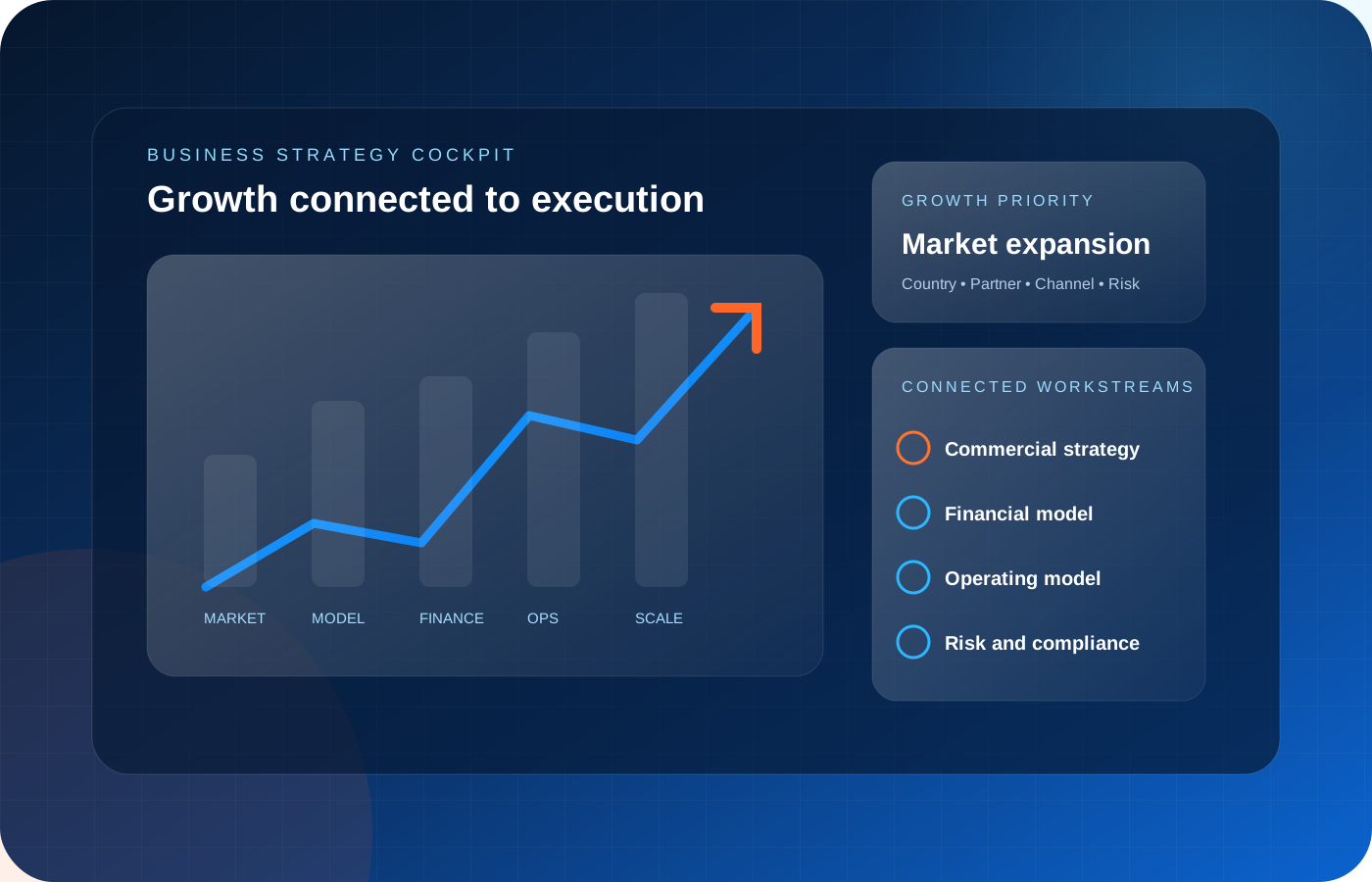
Business StrategyHow to create a business growth strategy
Connect market opportunity with commercial priorities, finance, capability and execution.
A decision becomes strategic when the commercial objective, financial logic, operating capability, risk and execution model work together.
A practical framework
- Clarify the commercial outcome. Translate the principle into a specific decision, action, owner and evidence requirement.
- Test the assumptions and evidence. Translate the principle into a specific decision, action, owner and evidence requirement.
- Connect finance, operations and risk. Translate the principle into a specific decision, action, owner and evidence requirement.
- Assign owners and milestones. Translate the principle into a specific decision, action, owner and evidence requirement.
- Measure results and adapt. Translate the principle into a specific decision, action, owner and evidence requirement.
Questions to ask before acting
- What outcome are we trying to achieve, and how will success be recognised?
- Which assumptions are supported by evidence, and which still need to be tested?
- What resources, responsibilities, dependencies and risks shape the decision?
- What should happen first, and what should not happen yet?
- When will the plan be reviewed and adapted?
How Identic Core Agent helps
Identic Core Agent helps organise the objective, current position, options, risks, actions, milestones and review points in one connected strategy environment. It can strengthen structure and continuity, while final decisions remain with the individual, executive, organisation or authorised professional responsible for the outcome.
Next move: Use the Strategy Architect to convert this topic into a road map built around your context and objective.
Turn This Insight Into a PlanBusiness StrategyHow to turn a business idea into an operating plan
Move from concept to value proposition, model, resources, launch and learning.
A decision becomes strategic when the commercial objective, financial logic, operating capability, risk and execution model work together.
A practical framework
- Clarify the commercial outcome. Translate the principle into a specific decision, action, owner and evidence requirement.
- Test the assumptions and evidence. Translate the principle into a specific decision, action, owner and evidence requirement.
- Connect finance, operations and risk. Translate the principle into a specific decision, action, owner and evidence requirement.
- Assign owners and milestones. Translate the principle into a specific decision, action, owner and evidence requirement.
- Measure results and adapt. Translate the principle into a specific decision, action, owner and evidence requirement.
Questions to ask before acting
- What outcome are we trying to achieve, and how will success be recognised?
- Which assumptions are supported by evidence, and which still need to be tested?
- What resources, responsibilities, dependencies and risks shape the decision?
- What should happen first, and what should not happen yet?
- When will the plan be reviewed and adapted?
How Identic Core Agent helps
Identic Core Agent helps organise the objective, current position, options, risks, actions, milestones and review points in one connected strategy environment. It can strengthen structure and continuity, while final decisions remain with the individual, executive, organisation or authorised professional responsible for the outcome.
Next move: Use the Strategy Architect to convert this topic into a road map built around your context and objective.
Turn This Insight Into a PlanBusiness StrategyHow to prepare a company for investment
Strengthen governance, financial evidence, business logic and investor communication.
A decision becomes strategic when the commercial objective, financial logic, operating capability, risk and execution model work together.
A practical framework
- Clarify the commercial outcome. Translate the principle into a specific decision, action, owner and evidence requirement.
- Test the assumptions and evidence. Translate the principle into a specific decision, action, owner and evidence requirement.
- Connect finance, operations and risk. Translate the principle into a specific decision, action, owner and evidence requirement.
- Assign owners and milestones. Translate the principle into a specific decision, action, owner and evidence requirement.
- Measure results and adapt. Translate the principle into a specific decision, action, owner and evidence requirement.
Questions to ask before acting
- What outcome are we trying to achieve, and how will success be recognised?
- Which assumptions are supported by evidence, and which still need to be tested?
- What resources, responsibilities, dependencies and risks shape the decision?
- What should happen first, and what should not happen yet?
- When will the plan be reviewed and adapted?
How Identic Core Agent helps
Identic Core Agent helps organise the objective, current position, options, risks, actions, milestones and review points in one connected strategy environment. It can strengthen structure and continuity, while final decisions remain with the individual, executive, organisation or authorised professional responsible for the outcome.
Next move: Use the Strategy Architect to convert this topic into a road map built around your context and objective.
Turn This Insight Into a PlanBusiness StrategyHow to design an effective operating model
Align people, process, technology, governance and resources around the strategy.
A decision becomes strategic when the commercial objective, financial logic, operating capability, risk and execution model work together.
A practical framework
- Clarify the commercial outcome. Translate the principle into a specific decision, action, owner and evidence requirement.
- Test the assumptions and evidence. Translate the principle into a specific decision, action, owner and evidence requirement.
- Connect finance, operations and risk. Translate the principle into a specific decision, action, owner and evidence requirement.
- Assign owners and milestones. Translate the principle into a specific decision, action, owner and evidence requirement.
- Measure results and adapt. Translate the principle into a specific decision, action, owner and evidence requirement.
Questions to ask before acting
- What outcome are we trying to achieve, and how will success be recognised?
- Which assumptions are supported by evidence, and which still need to be tested?
- What resources, responsibilities, dependencies and risks shape the decision?
- What should happen first, and what should not happen yet?
- When will the plan be reviewed and adapted?
How Identic Core Agent helps
Identic Core Agent helps organise the objective, current position, options, risks, actions, milestones and review points in one connected strategy environment. It can strengthen structure and continuity, while final decisions remain with the individual, executive, organisation or authorised professional responsible for the outcome.
Next move: Use the Strategy Architect to convert this topic into a road map built around your context and objective.
Turn This Insight Into a PlanBusiness StrategyHow to build a market-entry strategy
Select the market, define the entry model, control risk and plan implementation.
A decision becomes strategic when the commercial objective, financial logic, operating capability, risk and execution model work together.
A practical framework
- Clarify the commercial outcome. Translate the principle into a specific decision, action, owner and evidence requirement.
- Test the assumptions and evidence. Translate the principle into a specific decision, action, owner and evidence requirement.
- Connect finance, operations and risk. Translate the principle into a specific decision, action, owner and evidence requirement.
- Assign owners and milestones. Translate the principle into a specific decision, action, owner and evidence requirement.
- Measure results and adapt. Translate the principle into a specific decision, action, owner and evidence requirement.
Questions to ask before acting
- What outcome are we trying to achieve, and how will success be recognised?
- Which assumptions are supported by evidence, and which still need to be tested?
- What resources, responsibilities, dependencies and risks shape the decision?
- What should happen first, and what should not happen yet?
- When will the plan be reviewed and adapted?
How Identic Core Agent helps
Identic Core Agent helps organise the objective, current position, options, risks, actions, milestones and review points in one connected strategy environment. It can strengthen structure and continuity, while final decisions remain with the individual, executive, organisation or authorised professional responsible for the outcome.
Next move: Use the Strategy Architect to convert this topic into a road map built around your context and objective.
Turn This Insight Into a PlanBusiness StrategyHow SMEs can use AI for strategic planning
Use AI to strengthen structure, scenarios, documentation and execution discipline.
A decision becomes strategic when the commercial objective, financial logic, operating capability, risk and execution model work together.
A practical framework
- Clarify the commercial outcome. Translate the principle into a specific decision, action, owner and evidence requirement.
- Test the assumptions and evidence. Translate the principle into a specific decision, action, owner and evidence requirement.
- Connect finance, operations and risk. Translate the principle into a specific decision, action, owner and evidence requirement.
- Assign owners and milestones. Translate the principle into a specific decision, action, owner and evidence requirement.
- Measure results and adapt. Translate the principle into a specific decision, action, owner and evidence requirement.
Questions to ask before acting
- What outcome are we trying to achieve, and how will success be recognised?
- Which assumptions are supported by evidence, and which still need to be tested?
- What resources, responsibilities, dependencies and risks shape the decision?
- What should happen first, and what should not happen yet?
- When will the plan be reviewed and adapted?
How Identic Core Agent helps
Identic Core Agent helps organise the objective, current position, options, risks, actions, milestones and review points in one connected strategy environment. It can strengthen structure and continuity, while final decisions remain with the individual, executive, organisation or authorised professional responsible for the outcome.
Next move: Use the Strategy Architect to convert this topic into a road map built around your context and objective.
Turn This Insight Into a Plan